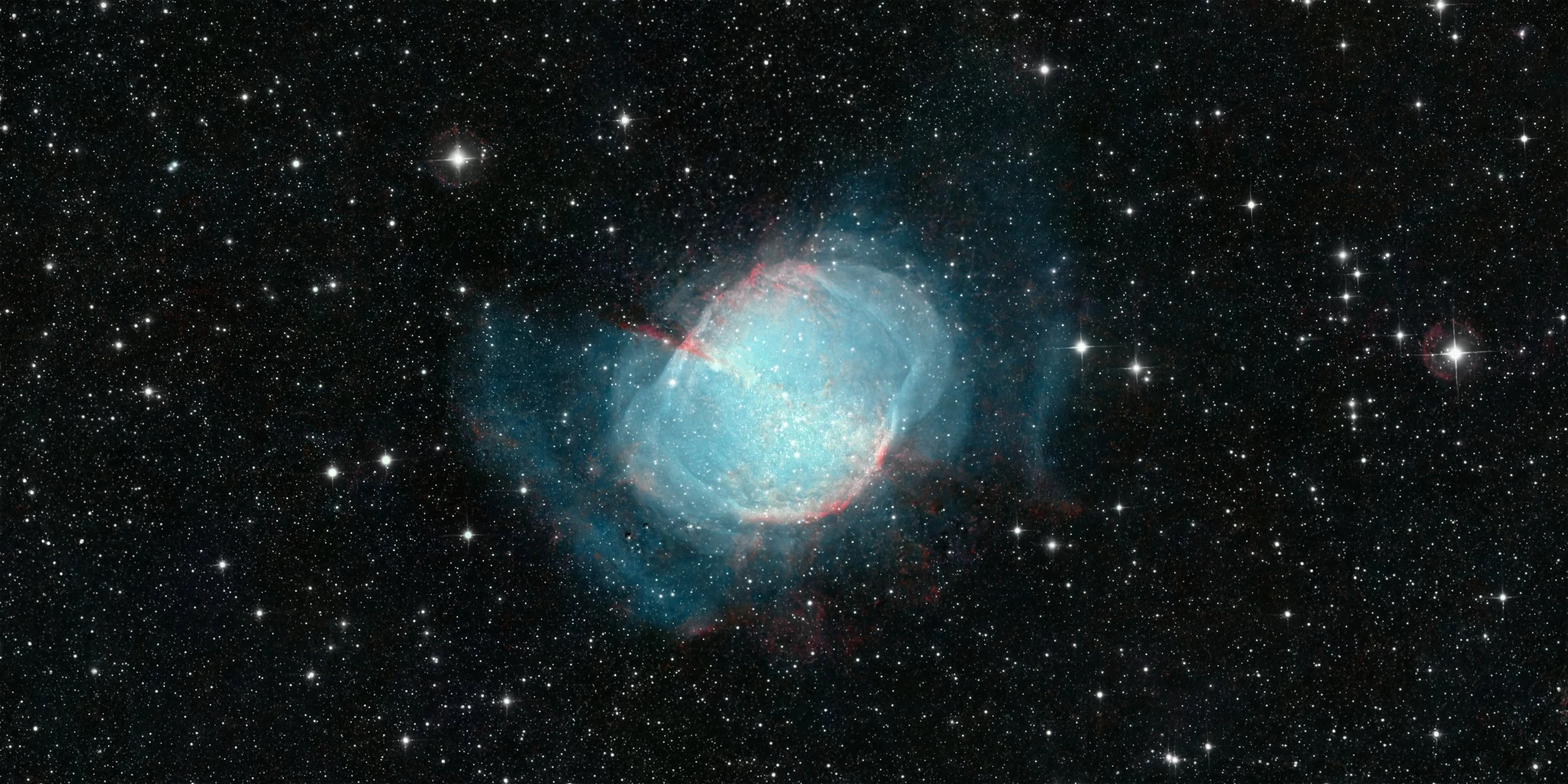
Messier 27
The Dumbell Nebula
📸 Acquisition details:
102 × 60s exposures (1h42m)
📷 ASI585MC Pro
🔭 Sky-Watcher Explorer 200P
🌈 Optolong L-eXtreme
⚙️ EQ6-R Pro
🎯 ZWO ASI174MM Mini + OAG
📅 29 April 2026
📍 Hoofddorp, Netherlands
M27 — The Dumbbell Nebula, Cosmic Butterfly or Apple Core?
A Dying Star’s Colourful Goodbye
At first glance this looks like a dumbbell from an interstellar gym, a cosmic butterfly, or perhaps an apple core . Whatever you see in it, the Messier 27 is one of the most recognisable and rewarding planetary nebulae in the night sky. Located around 1,200 light-years away in the constellation Vulpecula (the Little Fox, ‘Het Vosje’), M27 sits right in the rich star fields in the middle of the Summer Triangle in the Milky Way. It was discovered by Charles Messier in 1764 and was the first planetary nebula ever recorded. Its name, however, has nothing to do with planets: early telescopes revealed a small, rounded patch of light that resembled a planet's disc. The name planetary nebula stuck, even after astronomers realised what these objects really were.
M27 is the glowing remains of a star nearing the end of its life. Stars like our Sun eventually exhaust the fuel in their cores and expand into red giants. During their final stages, they shed their outer layers into space, exposing the hot, compact core that becomes a white dwarf. The intense ultraviolet radiation from this stellar remnant illuminates the expelled gas, causing it to glow. What we see is a brief but beautiful stage in stellar evolution: a dying star's final display before its outer layers disperse into space.
An Apple Core in the Milky Way
Messier 27 is a particularly rewarding object to observe. With an apparent magnitude of around 7.5 and an angular size of approximately 8 × 6 arcminutes, it is bright and substantial enough to stand out from the background sky, without taking up an enormous area of your field of view. Under genuinely dark skies, M27 can be spotted with binoculars as a small, hazy patch of light. A telescope reveals more of its characteristic shape, while long-exposure astrophotography brings out the intricate structure and faint outer regions that are much harder to see by eye.
The familiar dumbbell shape is also a matter of perspective. The nebula is thought to have a more complex, three-dimensional structure, probably resembling an hourglass or bipolar shell. We appear to be viewing it from an angle that emphasises the two brighter lobes. From another direction, the same structure could look much more ring-like, a little like the famous Ring Nebula (M57). In other words, two planetary nebulae can look very different simply because we are viewing their structures from different angles.
Why the Blue-Green Centre and Red Shell?
One of the most striking features of M27 is its contrast between a bright blue interior and reddish outer regions. These colours are not just decorative: they reveal something about the gases making up the nebula. The blue glow is largely associated with emission from oxygen, close to the extremely hot central star. The red edges are produced by hydrogen emission in the cooler outer parts of the nebula. Other elements, including nitrogen and sulphur, can also contribute to the colours seen in some images.
In my image, I particularly like how the bright turquoise centre appears to glow inside the reddish silhouette. It looks almost like the core of an apple, especially due the green-blue interior surrounded by a red outer shell, like the skin of a Fuji or Gala apple. And if I look at the extended lobes instead, which are only revealed due to long-exposure and many images, I can just as easily imagine a cosmic butterfly spreading its wings.
A Glimpse of Our Sun’s Future
Like many planetary nebula, Messier 27 gives us a glimpse of what could eventually happen to our own Sun. In several billion years, the Sun will expand into a red giant and later shed its outer layers. Its core will become a white dwarf, while the surrounding gas briefly forms a glowing nebula. And for a relatively short period in cosmic history, that process creates something that future alien life might observe as a colourful butterfly, an apple core, or perhaps simply a dumbbell floating in the Milky Way.