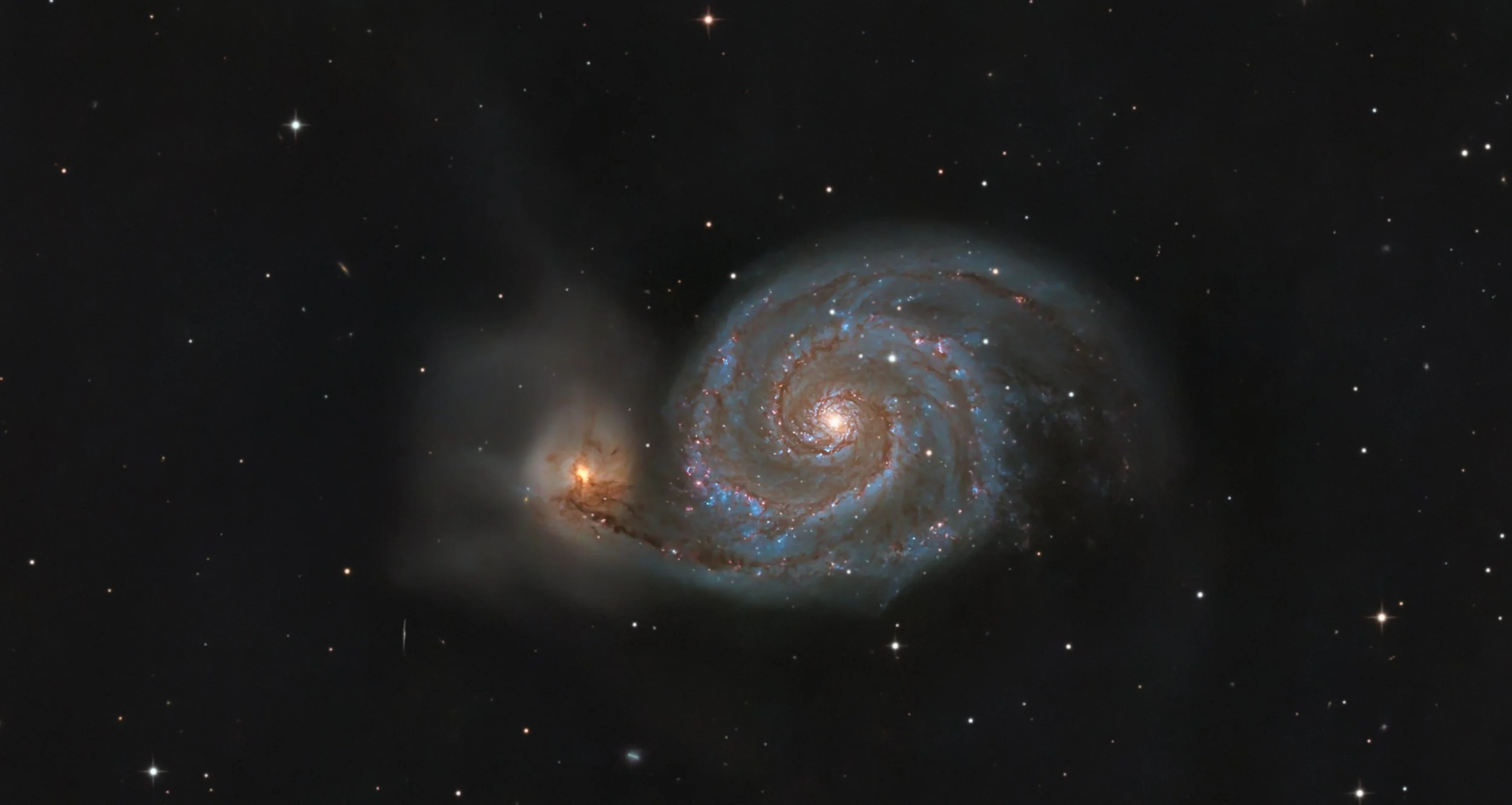
Messier 51
The Whirlpool Galaxy
📸 Acquisition details:
179 × 120s exposures (5h58m)
📷 ASI585MC Pro
🔭 Sky-Watcher Explorer 200P
⚙️ EQ6-R Pro
🌈 SV260 Multi-Band filter
🎯 ASI174MM Mini + OAG
📅 11 March 2026
📍 Hoofddorp, Netherlands
M51 — The Whirlpool Galaxy: Two Galaxies in a Gravitational Dance
A Spiral and Its Companion
Few galaxies demonstrate the beauty of gravitational interactions quite like M51, the Whirlpool Galaxy. Located approximately 31 million light-years away in the constellation Canes Venatici (the Hunting Dogs), this magnificent spiral galaxy presents us with a nearly face-on view of its elegant, winding arms. But look a little closer, and you will discover that M51 is not alone.
Just to the left of the main galaxy sits NGC 5195, a smaller companion galaxy with a bright, yellowish centre and dark lanes of dust. The two appear almost connected, as though the smaller galaxy is pulling on one of the Whirlpool's spiral arms. This is not merely a coincidence of perspective: the galaxies are interacting gravitationally, and their encounter has helped shape the spectacular structure we see today.
M51's spiral arms are filled with dark dust lanes, brilliant blue clusters of young stars and pinkish-red regions of glowing gas. Its central region shines with the combined light of a much older stellar population. Meanwhile, the smaller companion looks quite different, with a more compact appearance and prominent dust structures. Together, they form one of the most striking examples of interacting galaxies visible in amateur astrophotography.
How Two Galaxies Become Entangled
Galaxies are not solid objects. They are enormous collections of stars, gas, dust and dark matter, separated by vast distances. When two galaxies approach one another, their mutual gravity can dramatically alter their shapes, even though direct collisions between individual stars are extremely rare. As NGC 5195 passed close to the Whirlpool Galaxy, its gravity disturbed the larger galaxy's disc. Rather than simply pulling one spiral arm outwards, the interaction generated gravitational disturbances throughout the disc, strengthening the spiral pattern and creating waves that travel through its gas and dust.
Think of dropping a stone into a pond. The ripples spread outwards, disturbing the water as they travel. In a spiral galaxy, gravitational disturbances can similarly compress clouds of gas as they move through the disc. When sufficiently dense clouds collapse under their own gravity, they form new stars. This is one reason M51's spiral arms are so rich in star-forming regions. The dark dust lanes mark concentrations of interstellar material, while nearby pink nebulae and blue star clusters reveal different stages of the star-formation process. The companion galaxy has helped stir the Whirlpool's gas into a spectacular display of stellar activity.
The interaction has been unfolding over hundreds of millions of years. Hubble observations indicate that NGC 5195 is currently passing behind M51 from our viewpoint, although reconstructing the precise history of their encounters remains complex. What we see today is a snapshot of a prolonged gravitational dance, rather than a single moment of impact.
When galaxies interact, their gravitational forces can trigger bursts of star formation. But what happens after those stars are born? The brightest blue clusters in M51 contain hot, young stars that have only recently formed. Some of these stars are much more massive than our Sun. Although they burn through their nuclear fuel rapidly, their intense radiation and powerful stellar winds illuminate and reshape the surrounding gas. This is why some regions of the spiral arms glow pink: the ultraviolet radiation from young, energetic stars ionises hydrogen in nearby gas clouds, causing them to emit light.
In M51, the evidence for enhanced star formation is written across the spiral arms. We are not simply seeing two galaxies passing one another; we are seeing gravity influence how their material evolves, creating new generations of stars that will eventually enrich their surroundings.
Will the Milky Way and Andromeda Meet the Same Fate?
M51 offers a fascinating glimpse of what gravitational interactions can do, and it naturally raises a question closer to home: will our own Milky Way experience a similar encounter with the Andromeda Galaxy (M31)?
Andromeda is currently about 2.5 million light-years away and is moving towards the Milky Way. For decades, astronomers widely expected the two galaxies to collide and merge in roughly four to five billion years. In that scenario, their spiral structures would be distorted, tidal streams would stretch across the sky and the two galaxies would eventually combine into a larger system.
However, newer research published in 2025 has made that prediction less certain. Using updated observations from the Hubble Space Telescope and Gaia, astronomers found that the long-term outcome depends strongly on the motions and masses of other nearby galaxies, particularly the Triangulum Galaxy and the Large Magellanic Cloud. Their simulations suggest that the probability of a Milky Way–Andromeda merger within the next ten billion years is approximately 50 per cent, rather than a certainty.
If the two galaxies do undergo a close encounter, their gravitational interaction could disturb their gas and trigger new episodes of star formation. Over time, repeated encounters and the consumption or expulsion of gas could reduce the supply available for forming new stars. The eventual merged system might therefore look very different from the two spiral galaxies we see today.
Yet there is no reason to imagine stars crashing into one another everywhere. The distances between individual stars are enormous, making direct stellar collisions unlikely. The more significant changes would involve the galaxies' overall structures, gas clouds, stellar orbits and long-term star-forming activity. M51 is a real example of such processes in action. It allows astronomers to study how gravity reshapes galaxies and how these interactions influence the birth and death of stars — processes that may also shape the distant future of our own Galactic neighbourhood.
My First Encounter with M51
The Whirlpool Galaxy holds a special place in my own astrophotography journey because it was one of the first deep-sky objects I ever captured.
I still remember the excitement of taking my first 30-second exposure and running inside to show it off. At the time, revealing even a faint smudge of another galaxy on my screen felt extraordinary. The idea that I had captured light travelling for millions of years, using equipment in my own backyard, was almost unbelievable.
The deeper image at the top of this page is a rather different result. Its spiral arms, dust lanes and companion galaxy reveal far more of the system's structure than that first frame could show. It is a reminder of how much can be gained through longer integration, improved acquisition and processing, and the experience that comes with returning to the night sky time and time again.
I have placed that original 30-second exposure at the bottom of the page as a comparison. The difference is quite remarkable — and for me, it captures exactly what makes this hobby so rewarding: every image is another step in learning how to reveal the universe a little more clearly.
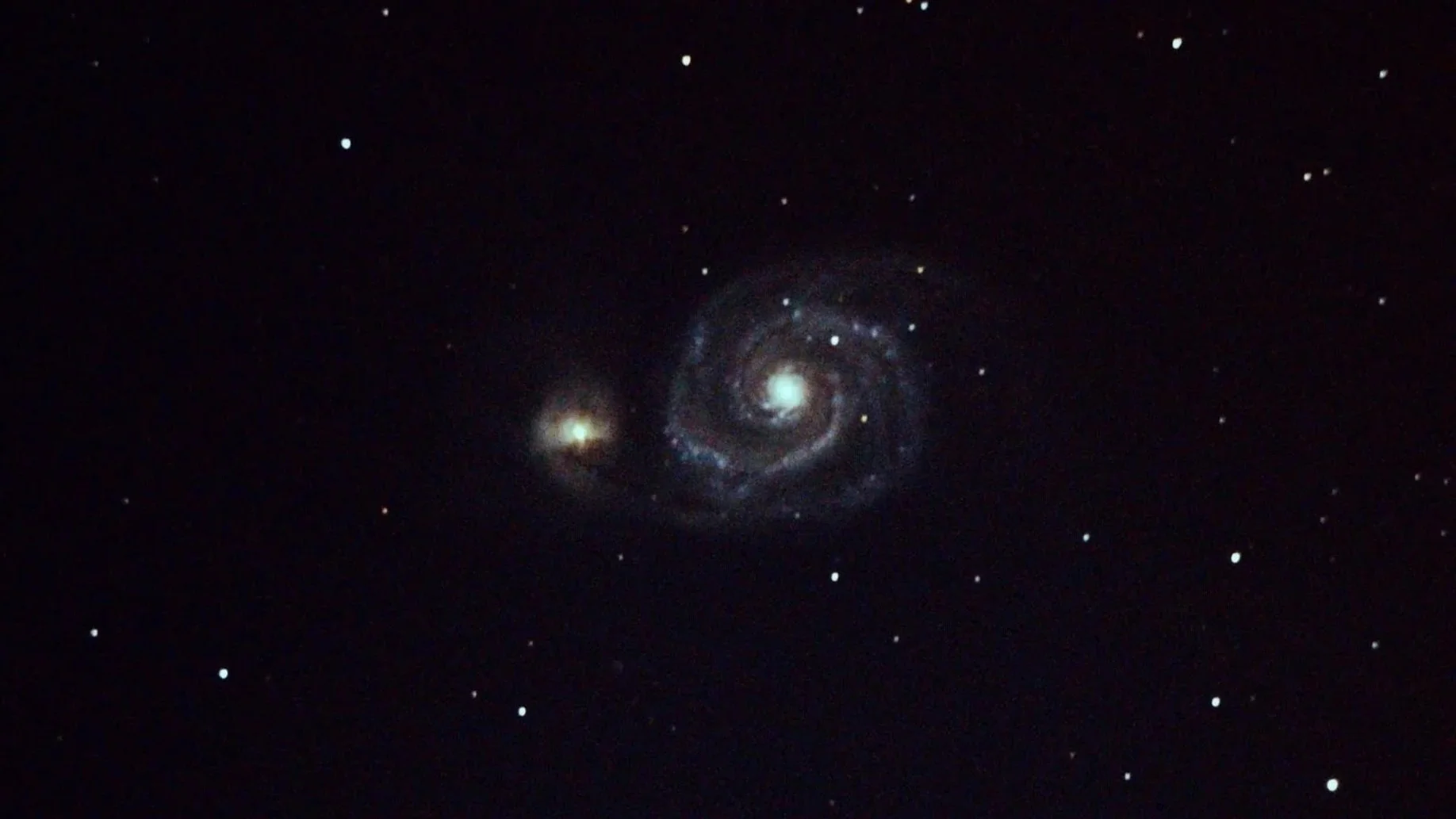
My very first DSO image
📸 Acquisition details:
5 × 30s exposures (2m30s)
📷 Nikon D3300
🔭 Sky-Watcher Explorer 200P
⚙️ EQ5
📅 4 July 2025
📍 Rochehaut, Belgium