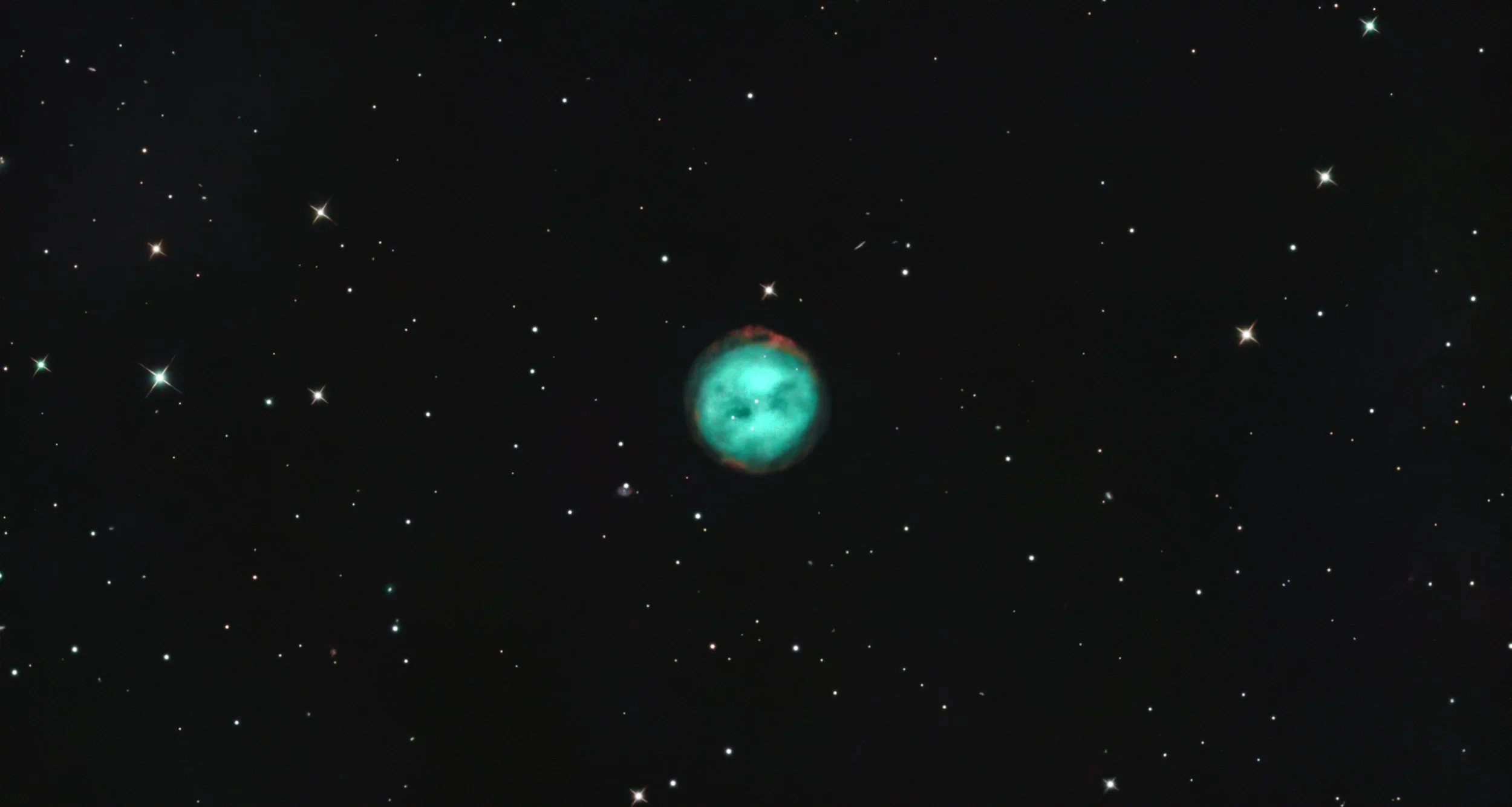
Messier 97
The Owl Nebula
📸 Acquisition details:
234 × 30s exposures (1h57m)
📷 ASI585MC Pro
🔭 Sky-Watcher Explorer 200P
⚙️ EQ6-R Pro
📅 13 December 2025
📍 Hoofddorp, Netherlands 🇳🇱
Messier 97 — The Owl Nebula
An Owl in the Night Sky
Two dark eyes stare out from a glowing cloud of gas, giving M97 one of the most memorable appearances in the night sky. Known as the Owl Nebula, or NGC 3587, this planetary nebula lies approximately 2,000 light-years away in the constellation Ursa Major, the Great Bear. It’s a relatively compact object in the sky. Despite its modest size and fairly low surface brightness, it can be observed with amateur telescopes, particularly under dark skies.
The Owl Nebula was discovered by French astronomer Pierre Méchain in 1781 and was subsequently included in Charles Messier’s famous catalogue as M97. The term planetary nebula is somewhat misleading: these objects have nothing to do with planets. Through early telescopes, their rounded, often disc-like appearance resembled distant planets such as Uranus. Today, we know that they are glowing shells of gas expelled by ageing stars.
How Does a Planetary Nebula Form?
M97 shows us a brief but spectacular stage in the life of a star similar in mass to our Sun. Its story unfolds over millions of years, although the glowing nebula itself exists for only a relatively short time on cosmic scales.
1. The star begins to run out of fuel. During most of its life, a star like the Sun produces energy by fusing hydrogen into helium in its core. Eventually, the hydrogen in the core becomes depleted. The core contracts and heats up, while the outer layers expand dramatically. The star becomes a red giant. Later, helium fusion and further changes in the star’s interior lead it into another advanced stage of evolution, known as the asymptotic giant branch.
2. The star sheds its outer layers. In its final giant phases, the star loses substantial amounts of gas through powerful stellar winds. Pulsations and changes in the rate of mass loss can produce successive layers of material, while dust may form in some of the cooler expelled gas. These layers spread outwards into space. Their density and structure reflect the changing conditions under which they were expelled, rather than a single explosive event.
3. The exposed core illuminates the gas. As the star loses its outer envelope, its hot core becomes exposed. The remaining core contracts and heats up, eventually reaching temperatures of around 100,000 degrees. Its intense ultraviolet radiation ionises the surrounding gas, stripping electrons from atoms such as hydrogen and oxygen. As these atoms and ions interact with electrons, they emit light at characteristic wavelengths. The expanding gas begins to glow, revealing the structure of the material that the star shed earlier.
4. A white dwarf remains. The exposed core eventually becomes a white dwarf: an extremely dense stellar remnant no longer powered by sustained nuclear fusion. It continues to illuminate the surrounding nebula for a time, but the gas gradually expands and disperses into interstellar space. Over much longer timescales, the white dwarf itself cools and fades. The nebula is therefore a temporary display surrounding a stellar remnant that will survive for billions of years.
Three Shells and Two Mysterious Eyes
One of M97’s most fascinating features is its layered structure. Astronomers have identified a faint outer halo, a more prominent middle shell and an inner shell with a more complex, roughly elliptical structure. These layers are evidence of the changing phases of mass loss and stellar winds during the star’s final stages.
The two dark patches that give the nebula its name are especially intriguing. They resemble the eyes of an owl looking out from the glowing shell. They are not simply two solid objects or necessarily clouds of dust blocking the light. Instead, they are regions where the nebula emits less light, forming cavities within its brighter inner structure.
Earlier models described these features as a pair of cavities within a roughly barrel-shaped or bipolar structure. More recent studies suggest that the inner region may be even more complex, with multiple cavities and a more intricate three-dimensional geometry. The exact origin of these structures is not fully settled, but they likely preserve clues about how earlier stellar winds shaped the expelled gas.
The apparent eyes are also a reminder that we see the nebula in projection. Its three-dimensional structure is compressed into a two-dimensional image, so different shells and cavities overlap along our line of sight. The result is the recognisable owl-like face that makes M97 such a rewarding target for astrophotography.
Reading the Colours
The Owl Nebula’s colours reveal different physical processes within its gas. The reddish regions are largely associated with hydrogen-alpha emission, produced when ionised hydrogen recombines and emits light at a wavelength of about 656 nanometres. The blue-green glow commonly seen in its central regions is strongly associated with emission from doubly ionised oxygen, known as [O III]. These oxygen atoms have lost two electrons, and they emit characteristic light under suitable physical conditions.
The distribution is not perfectly separated into a red outer shell and a blue centre. The relative strength of each emission depends on the temperature, density and ionisation state of the gas. Some parts of the nebula emit strongly in hydrogen, others in oxygen, and there can be substantial overlap. In addition, reflected light from the hot central star can contribute a bluish component. The precise appearance therefore depends on the filters used to capture the image and the way the data are processed.
In astrophotography, these colours are more than decoration: they allow us to distinguish regions with different physical conditions. What appears to be a simple glowing cloud is actually a complex structure of shells, cavities and ionised gas, still carrying the imprint of the star that created it.